
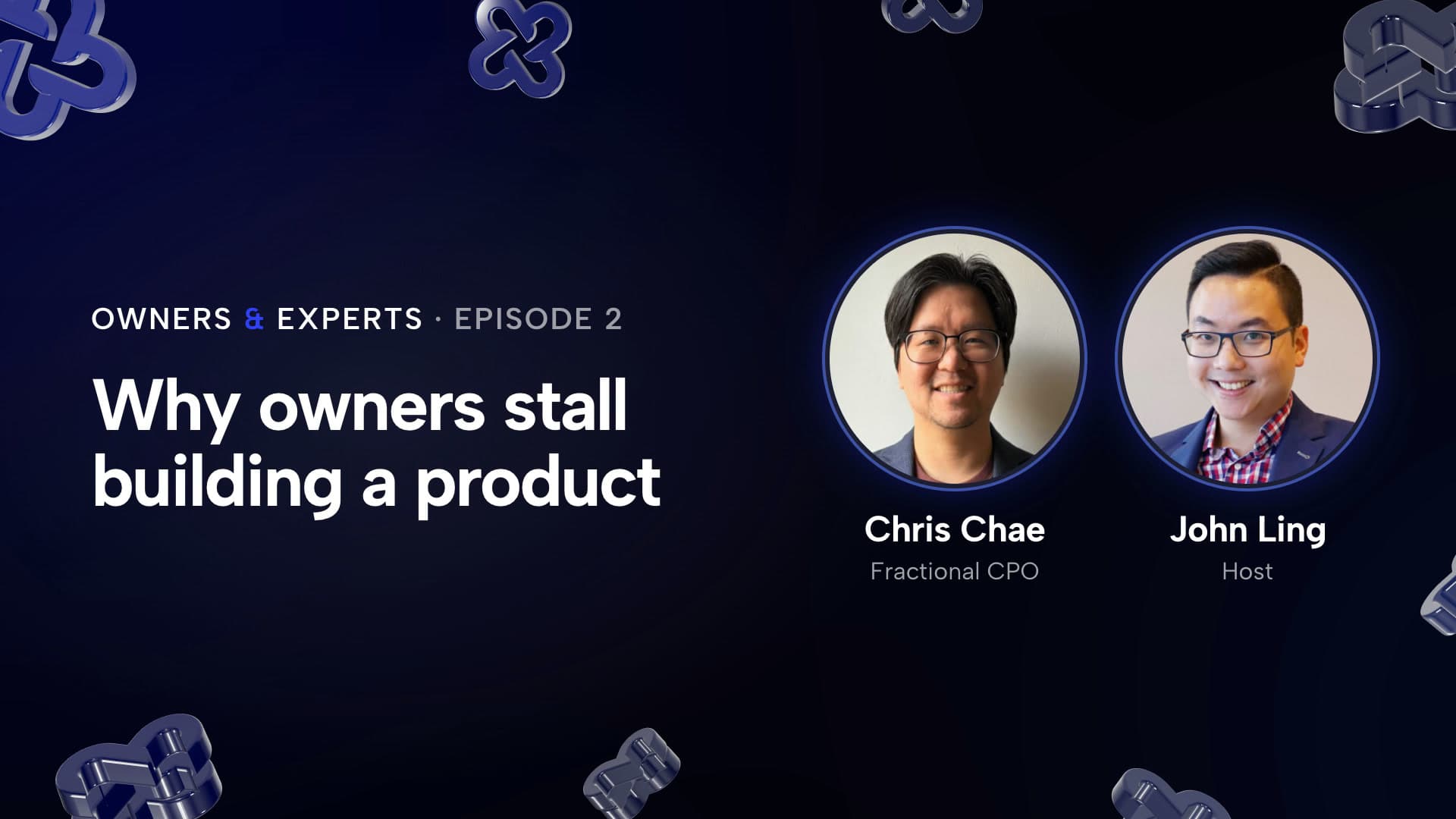
Owners & Experts · Episode 243 min
Why owners stall building a product
Chris Chae, Fractional CPO
Last episode, Justin Wood told owners to just build a product. Chris Chae has spent 15 years building them, and he’s watched owners hire engineers, hand them “what to build” a couple of hours a week, and stall.
In this episode
- Why every product person should own a number
- Rebuilding an acquired business for a new market: picking a new customer and turning the old community into evangelists
- Growing a new line without cannibalizing the core
- Why the customers you turn away tell you what to build next
- Whether every $5–20M business should build a product
- What product is for now that AI has made building cheap
- Why owners stall, and when to bring in product help
Try this week
- Look at the customers you’re turning away. They’re telling you what to build next.
- Build something small yourself, even in a tool like Lovable, to learn how product works.
- If you hire engineers, don’t give “what to build” two hours a week. That’s where owners stall.
Chapters
Links
Chris and John worked together at Flipp, and he’s been advising CollectiveXP this year. This episode isn’t sponsored.
Read the transcriptHide the transcript
John Ling: Last episode, Justin told you to just build a product.
Chris Chae: If it's so cheap, you can just sort of spray a bunch of stuff at the wall, and who cares? I would say actually that's the wrong way to look at it. They end up kind of stalling, spinning, where they're doing a bunch of things that feel productive, but nothing's actually moving.
John Ling: So who is right? Today, the product guy is going to tell us exactly that. Welcome to Owners & Experts. Last episode, Justin said every five to twenty million dollar business should build a product. But what product do you build? Today, we talk to Chris Chae, who spent 15 years in product, leading teams at a startup studio and fintech companies. For disclosure, Chris and I worked together at Flipp, and he's been advising us at CollectiveXP.
John Ling: You've been on both sides, building the product and owning the number. So what changed when the number was yours?
Chris Chae: Yeah, here's a bit of a hot take. I think all PMs should own some sort of number. Now the difference in terms of sort of the P&L is you go right up to the sort of top line and bottom line, right? And so what ended up happening is In that a GM style role, if you will, you end up having to know a lot about a lot of different functions. The classic product leader is like really good at design, really good at the technology, and we'll also have a you know pretty good idea of the business. But when you're owning the sort of top line and bottom line in the PL, like you have to know everything. Like you have to know like partnerships, marketing, customer support, like so the entire business. Becomes part of your system that you use to then move commercial results. Like a pure product person, they bring ROI, commercial ROI, through the technology. And so that was the sort of like shift that I noticed. And I think what's happening, especially nowadays with AI, is you're starting to see people who are talented with AI be able to actually expand their leverage, pick up on these different functions a lot quicker than they had in the past. So I actually kind of think like you know five, ten years from now, like the best product people will sort of be will have that kind of a mindset, right? Because they'll be able to use this amazing technology that's coming out now to have that kind of an influence. The days of the product manager as the just the person who is the delivery person and they're measured by, did you ship on time? I think those days are coming to an end.
John Ling: But your experience is super interesting when it comes down to from a product leader role to then having to really own the P and L when it comes to your experience at sportsbook. Yeah. Do you wanna share little bit about that?
Chris Chae: Yeah, so just to g lay the groundwork a little bit, so Sportsworth Review is a sports media content site, right? And it's essentially an affiliate business that works with, the fan duels and the DraftKings of the world to send them qualified leads. And the way that this business makes money is through deals with those kind those sports books, right? There's lots of different ways you can structure the deals. But fundamentally, you know, the role of this business was to get the attention of sports betters, all different types of sports betters, build a relationship with them and then commercialize that relationship, right? And so, you know, sports work review has been around since like the 90s. It's super old. And it has like a really strong core, hardcore following of sports betters. Like if you just think about the 90s, that community of people has been together for almost twenty, thirty years, right? And so what was happening is the market was changing. So sports group review, sports betting in general, was in this unregulated, particularly in North America, right? It was unregulated. And what happened recently in the last few years was sports betting became regulated in the US. And so the owners of Sports Broker View had to you know think through a decision, a key decision. The market's changing, so product market fit is sort of gonna change, right? Because of this regulatory change. Do they want to double down, invest more in this business, and adapt it to the new world, right? The new regulated world? Or do they want to sell it? And they want to, you know, either get some help or even just completely divest of the property, right? And so the buyer was a small, I'll call it like a roll-up, called Legend. And Legend owns like 50 different brands across sports betting and casinos. They actually just recently got acquired by Sports Genius for $1.6 billion, just to give a sense of the scale. But Sports Review itself was sort of like a $10 million business, let's just say. So they hired me to come in and essentially make sure that acquisition was successful. I wasn't part of the transaction necessarily, but I came in after to be the P&L leader and make sure that the thesis hit. The thesis was we're gonna buy this property, we're gonna make it work in these in the regulated markets. And yeah that was sort of like a almost a two-year process to kind of like turn it around and there was a lot involved in terms of you know rebranding the business repositioning it rebuilding the underlying technology and really just thinking through like okay well what does the ideal customer look like in this sort of new world right So yeah, it was a team of about 30 people that I worked with to go through that sort of like turnaround of the acquired asset.
John Ling: That's crazy. I think that most people wouldn't have that kind of experience to do that for a ten million dollar business. I'm assuming that when you first come in, there's probably changes that you need to make, product that you probably have to kill, product you have probably have to create. Walk me through the first change, first major change where it could have a impact to existing revenue, but probably will bring no some something new after.
Chris Chae: Yeah, there's so much. We picked a customer, so we wanted to center around a customer that was actually different than the tradition traditional the traditional business had typically served, where it was not like this hardcore sports better who had, was used to wiring money through Western Union and things like that, right? This was like a new type of customer because again, if you go into a new market, it's regulated. You know the thesis was that we could serve a lot higher volume of customers that were maybe more sort of casual or newer to sports betting. And so it's like The thesis was can we actually leverage that existing user base almost like an asset to sort of help bring in some of those newer, cat more casual sports betters, but focus a lot of the sort of like the branding, the feel, like the experience around that new customer in the regulated betting markets. And so, you know, what we ended up doing was sort of working with the existing user base. There was a few people who you could tell they were invested in this as a community, right? You think of this as a product, but actually it was a community. And these people wanted to be a part of the next phase of the community. And you know, by helping to productize certain experiences, you could actually end up, you know, creating ways to incentivize the old users, you know, the old guard or the hardcore users to help out the new users. So a simple example of that was we had you know moderators on the forums who would give like points to some of these users, whenever they helped new users with questions, right? So, you know, like a new user would come in and be like, hey, like they would ask a simple question about you know how does sports betting work, like what is a money line, like I don't understand how to read these odds, and you can read content and things like that, but you know, they would for whatever reason they would ask on the forums too, and by incentivizing the existing user base to help out these people, were able to earn these points and the points gave them two things. It gave them status in the community, right? Which is actually probably the most more valuable thing. But also you could then spend some points and you could buy stuff in the sports book reviews store. Everything
John Ling: Right, right, right.
Chris Chae: from merchandise to pizza vouchers and things like that and you know over time you end up sort of adding sort of unique items to the store that reflect the culture of that community. Yeah. So that was actually I didn't cover it in the beginning, but one of my l lessons was like the community was a huge part of that business.
John Ling: Right. And no social proof is like the incentive to get them no really into this, right?
Chris Chae: Yeah, exactly.
John Ling: Yeah. Okay, cool. So from the side of it, it's like you know, you're just you're actually extending the product so that the product or sorry, the existing people became evangelists to gash to get a larger following. Interesting. Yeah. So
Chris Chae: Yeah, yeah, exactly.
John Ling: s so technically not killing a product, just expanding it.
Chris Chae: Well we did end up killing some products that weren't what we deem to be part of the ideal offering for the new user, right? What I would say is it was a heavy focus on how do you best serve the new user, but without losing the old user, right? And when you're doing sort of like this evolution, where you've got an existing working product and you're trying to grow and you're trying to add new products on top of it, you have to be very careful not to cannibalize your existing business, not to jeopardize your core business when you're trying to grow and make these new bets. And actually like the ideal scenario is you're able to sort of find the way to accelerate both. Like you're able to leverage the core to fuel the gr to fuel like the new products or the new growth, right? And so that was the thinking again behind that well, we have this really passionate user base. This user base may not represent the full TAM of the market, but we can use them to help grow with this new audience. That was the overarching strategy. And so yeah, the community, the points, that also informs the well, how do you brand this thing? How do you iterate on existing products as well?
John Ling: Right, right, right, right. Super interesting because like I think going back to the I guess the last episode when Justin started mentioning that every w everyone within the audience, like no the five to twenty million dollar business owners in Canada, everyone should be building products and everyone should be creating products. I guess what you're saying is that it's important to build a new product only if it fits within your current offering and solution. You cannot just no go wild and start creating all these different things that does not really contribute to the same experience.
Chris Chae: Yeah, I would say that's the path that makes the most sense most of the time. Y at so, I also spent almost three years at Neo Financial, right? And so Neofinancial when I joined was mostly a single product company, the first unsecured card with a co-brand partnership with HBC. But the vision for NEO was always much broader to serve Canadians with a number of different financial products and build out like an ecosystem of products, right? Like a full digital banking suite. And so yeah, like that experience was like we expanded into sort of like banking products, deposit products, savings products. We expanded into mortgages. We even did things like insurance products through partnerships, right? Wealth through partnerships. And so when you in even in that example when we're expanding we had pretty specific customer archetypes and personas that we had built over time that, you know, we were trying to be very intentional when we were expanding into those different product lines. Okay, well, does this help an existing customer where we already have a strong relationship? Or is this sort of a customer where we know about them, but we don't necessarily have the right to win them today. Okay, well, that's fine, but how do we get there, right? And so you're constantly balancing this shorter term priorities versus the longer term. And I think it's important to always have both in mind because, you know, if you're thinking too short term, then you'll never sort of get to the end destination you'd envisioned from the beginning. So it was like balancing that, right? So yeah, just to go back to your point, it's like you have to keep the core customer in mind and make sure you're serving them as you grow this business, but you also have to be able to zoom out and look a little bit further ahead and be like, okay, well, in a couple of years we want to be over there, right?
John Ling: So when it comes to I guess like no these like customer profiles or personas, I think that like we have from I guess from a tech company there it's like very top of mind and like no we understand that but for some of the audience they may not be coming from this. Can you tell me a little bit about like maybe a story of like a persona that you're focusing on and how that informs maybe a couple of examples of products that you that helped you make the decision within your experience.
Chris Chae: everyone kind of I think has a high level idea of like know your customer and serve the customer, right? And what that means, like you were just talking about, you know, how does a tech company do it? I think every business should do this actually, but it's a combination of Getting to know what your customers are actually doing in the real world. What are the real pains? What are the ways in which they're trying to address those pains but they're not able to do so, right? And what are some solutions that they're they'll pay for? I think And there's a lot of different ways to get that data. You can obviously go out and talk to customers, you can look at data. So, in an online technology business, there's lots of tracking of what people are doing inside your product that can help inform that. So at New, for example, a really simple example. We started noticing in the funnel that there was a bunch of people so again, the final is the application process, right? So a person's interested in opening up a credit card, let's just say, right? To go through the application process. You know, they either get approved or declined, and that's based on sort of a risk assessment, let's say. And then there's a whole bunch of other factors like how much do you want to lend them and et cetera, et cetera. But what we started noticing was that there was a segment of people that kept coming to the door essentially of the business but were getting churn away But would still keep coming back through a different door. It's like a different product
John Ling: Mm.
Chris Chae: that we had not envisioned or we had no idea that they would actually be interested, right? So they would open a banking product, a simple sort of you know checking account, and then they would just go dormant. The they wouldn't do anything, right? So there's okay, clearly they're still looking for help. So what are the things that we can do to help them out? So again, that's an example of like, you know, you look at the data and you're like, why are these people still trying to come in? And so that sort of how do you get the answer to that question? Well, the data will lead you to somewhere, it'll give you the sort of the smoke, but in order to actually really understand the why, it requires, following up, having a conversation with these customers. So we did a you know what I'll say is a couple of sprints of customer validation, talked to a bunch of these customers, and came to understand that actually there was a few different things going on. But what it came down to is they were still looking for help and There was a solution that was fairly cheap for us to build to help serve them. And so it's like going back to that, that, that overall principle of just like, can you expand on what you're doing with existing customers? We had these customers that were coming in that we hadn't built a relationship with, and they were showing us that they were looking for more. And we talked to them and essentially got the sort of insight we needed to then build the next set of products for them. Right? That example is maybe atypical for most businesses, because you might it might be harder to get that you know, I'm not sure that you'll always have the data to be able to give you that information. But fundamentally I think if you have a certain audience that you have the right to win with a relationship with or that you have some existing relationship or conversation with, absolutely keep talking to them, keep seeing how you can help serve them, right? And in this case it was people who had been declined for a certain type of credit product but would have been approved for others. Yeah, so again it's like super simple example, but it's like that process over and over again helped us sort of grow you know like basically triple the revenue over time.
John Ling: Triple the revenue. Okay. So, well, I know what you mean. I think a lot of the businesses within five to twenty million dollar range, not sure how strong their data layer is, whether they're able to discover, but I have a feeling that they probably do have no maybe a group of customers that's underserved, that it just never really had the time to go in and just understand. Which brings but brings me Back to the question that or the statement that Justin said. Justin mentioned that everyone should have a product and like no go start today, like you know, just go build. Like what do you think? Do you think Justin's right? Or like you know, as a business owner, I assume that like you know you'll be super busy, right? How do you actually go through the type of different customers that you have and actually fish out these like really good insights or really unserer needs that could eventually triple your business.
Chris Chae: Yeah, It really depends. I think you know, you mentioned Justin said everyone should build a product at a certain stage, right? And I think the benefits of building a product, I think what he was talking about is probably just a pure services-based business probably scales linearly with headcount. And so with the product, then you get the economies of scale. And that's so that's probably how you grow quicker after a certain point. But yeah, like I imagine there's so much you can learn. In a services business where you have to naturally be so close to the customer that would inform the ability to then identify these opportunities where it's like, well I could solve this with a product and b and build those products over time. So I think I agree with the spirit of what he was saying. But I think there's also lots of successful service businesses that don't necessarily need to build a product for a long, long period of time. Yeah.
John Ling: Right, right. Right. That's a fair point. Yeah, like Justin was actually like his statement, I if I remember correctly, was that the product is a marketing, right? Because when you're like a lot of the times when you're trying to build first of all product scales a lot easier than like you know, just a pure service. I totally understand that. I've been thinking about how like what you described about the idea that you should understand your aud your customer profiles first and your personas first. Before building the product. That resonated a lot because I think that's how you can design a better experience where people understand, yeah, you are the company that do this and this is how I see everything working together to give me a better experience. Right. So that I totally understand. Maybe this is a time where we can shift gears because the reason why we're even talking about this is because AI has kind of changed a world where It used to be that if you want to build product, it's super expensive. I just remember a year ago we spend I think what, half a million dollars building a company and that's around the software. Whereas today I probably wouldn't do that. I would probably be able to build that software much faster and launch it much quicker without having to hire a whole team of people to do it. So what does that mean for a product role? Like, you know, and this I think we're talking about future here. So no, we don't have to be worried about it's just our viewpoint. What do you think? Where what is product what does product mean in this AI age?
Chris Chae: Yeah, like I was saying, I think the role of a product manager fundamentally is to achieve commercial ROI through technology, right? And so the traditional, let's call it pre AI, way to do that was to like make sure that the technology that you're building, the cost side of it was super expensive. So it's very important that you have somebody to manage the output and the outcomes that are being driven through those really expensive engineering teams, right? And now what I see a lot of is like when every time I scroll through my LinkedIn or whatever, it's a lot of like Who cares? We can just like you know, engineering's cheap now, we can just use agents to do everything, right? And so what a lot of people are thinking, I think, is that, okay, well, if it's so cheap, do we need product you can just sort of spray a bunch of stuff at the wall, and who cares? It's so cheap that like even if you get it wrong, you'll just eventually get it right, right? It's so cheap you can just use volume to get to where you need to go. And I would say actually that's like that's the wrong way to look at it. Product driving that commercial ROI is not just a the cost side of the ledger to make sure that you're not o overspending. It's actually understanding an ambiguous problem, understanding a customer and the business and the technology to be able to then more capture opportunity on the upside, right? That's where I think the best product people are really good at. The bottleneck is not engineering. It's actually even I would say before AI, I would say most of the bottlenecks from my experience that I've seen and across like lots of different businesses, it's actually more either sort of the operating efficiency of the company or the direction that the company's going. And so product helps,
John Ling: So yeah.
Chris Chae: from a product perspective, make sure that all those investments are aligned with the overall sort of like business or corporate direction and to drive ROI across that product surface.
John Ling: Hmm. Yeah, so yeah, the shortage, I think that the shortage is no you're right. It's always been like no having the right direction or having the right experience judgment would really be the leverage, not so much the tooling that you have. Hey, I'm going to like quickly ask one thing 'cause within the audience there is going to be a camp of people who are already leveraging AI, understand a little bit about product and like you know, understand how product people can improve and like elevate. How about the camp that's hasn't really touched AI, like you know, had kinda has been on the sidelines. Do not have a product team and felt as it's just looking at this investment in product or investment in AI as something that they haven't tried before. For that group of people, what's your advice for them?
Chris Chae: Yeah, so people who are new to product.
John Ling: Yeah. Or just in a different industry where 'cause tech is I feel like almost like our own little bubble, right? And
Chris Chae: Yeah.
John Ling: yeah. So we think in a slightly different way, if you may.
Chris Chae: I think if you're running a business, whether it's a services business or a product business or has a bit of both. Actually let me rephrase that. If you're running a business and you have a product, even if you don't have a product manager, someone's wearing that hat. And so by default, it's probably the business owner or somebody, right, who's involved in that business. And so the question just becomes like Are you doing that as effectively as you can? And at a certain point, do you need somebody to do that as a full-time job? And that depends on the business, the type of business. What I would suggest for people who are just starting to dip their toes in this, there's a lot of content online. There's almost actually too much content online on this stuff.
John Ling: Yeah.
Chris Chae: I would say like If you're new to product, if you're like a services business that is building products for the first time, there's no better way than to just get in the saddle and just build stuff. Now that is kind of counterintuitive to what I was just describing, where it's like, you know, you need product people who know what they're doing, but that's how you learn, right? My fear is like What most people these days will probably do is they'll ask like ChatGBT or something, like, what does a product manager do? How do I build product? Whatever. And I think that can help for sure, but
John Ling: Right. Yeah.
Chris Chae: we're still kind of in this phase where it's hard to build that judgment and that experience without actually doing the role yourself, like reading about it and then doing it yourself and going through the struggle of like making mistakes.
John Ling: someone feel something and nothing no one comes to see it, for example, right?
Chris Chae: If you don't do that, you won't get good at it, and then your ceiling of capability will be constrained to whatever the LLM tells you. And then you're basically like your potential your ability to drive you know product ROI is gonna be the same as whatever you know whatever that LLM is. So that's why I think it's important, it's atypical maybe from other types of jobs, but I think you just have to go in there and build products and do it more from the perspective of having fun and learning. And then that will give you the judgment that you need to then be able to actually to increase your force multiplication like leverage. And I think that's true in a lot of different things with these LLMs. They're really good at they're really good at helping people achieve a certain baseline level of knowledge across different topics. But because product is sort of the It's the aggregation of a bunch of different things. You have to go out there and do it. Otherwise I just think it's not really going to lead to the c the capability that will drive the maximum product ROI that your business can
John Ling: Mm-hmm.
Chris Chae: be having. Right?
John Ling: I hundred percent agree. But I think that like, you know, I'm just putting myself into this camp, like people in this camp like being into their shoes. I have a feeling that the question that I may have is, okay, I can build something. I can try s try LM or try something to start, but where do I start? What is the f like how do I take the first action? Like where do I start? What is the one thing that I can use as my first step that can lead me to using AI to solve a problem?
Chris Chae: Yeah, I think the simplest thing is probably use something that makes it super easy to get something out the door. Like a lovable maybe, right? I see I know a lot of people using like those types of tools to just sort of bring their ideas to life. And I think that will naturally lead to you starting to pick apart your product, once it's live out there, especially if you're able to get it in front of customers. And you know, if you have customers start to use your product or even pay for your product, you'll very quickly realize all the different things that are necessary to drive like that commercial ROI on your product. So I think like just get out there. And the simplest way to get out there. Some of these LLM tools can do it too now, but lovable's a I think a good example where they try to make it as easy as possible s for somebody to build a product and now they're even trying to enter distribution, right? As a job that they're so they're solving for. So you know, I have friends and family and you even you know, my neighbor who's like a general contractor, he's like he's trying to get into this stuff. And he's dabbling in these AI tools and he's in the last few weeks even, just like by the fact that he's just like getting in there and trying to ship. I can see sort of the improvement already and sort of the product, how he's thinking about it. So I yeah, I mean I would encourage anybody who's got that itch and has a business where they want to sort of build products on top of their business. It's very cheap to try and t to learn. It'll take some time to get really good at it, obviously, but the barrier to entry is super low. So I think everybody should be trying it right now. I have
John Ling: Right. Yeah.
Chris Chae: a I have a five year old kid and I'm trying to get him to do stuff. He's expressed interest, right? And so like, yeah, there's really no excuse anymore to just sort of like get in there dabble. And that's how you get good eventually. You just have to get in the ring, right?
John Ling: I do I guess no that so I guess to paraphrase from your perspective for next Monday anyone who's listening, like their next step is to just go sign up for a lovable account. Think about like no what their customers or their customer profiles is currently facing as a problem. Or even like themselves, you know, and try to do something. Because you're right, like I hear everyone around me. I remember having a window caulkings guy. Came over and while he's doing it he was just telling me that he's like using AI to automate like all the business not outreach but all the in inbound business like answering. He's using AI to automate it. I was like, yeah. I feel like that's it's happening faster and sooner and like no almost everywhere. And I just find it super interesting. Awesome. So I guess any advice you ha you would give to like no a business current business owner, five to twenty million dollars in scale within Canada, any advice that you would give, like you know, should they explore, like you know, talking to a product person?
Chris Chae: Yeah, a lot some of the conversations that I've had with folks like this, they're often not coming from technology backgrounds. They're often coming from like completely different industry, but recognize that their business could benefit or even like exponentially ramp up their business through technology and obviously like AI as part of that, right? And most people start from a place of, okay, well, you know, I know my business. I know the things that the opportunities. I'm gonna hire some engineers and I'm gonna tell them sort of to build this thing and then everything will be great. And I'm gonna do it with the sort of like a couple hours a week that I have time to do that, right? Because you're all you're running a five million dollar, ten million dollar business already, right? And then they very quickly realize, okay, this isn't working. I made all these bets. Why isn't it working? It doesn't make sense. I know the customer, I know the problem. Why aren't they using this thing? What's the problem? And then they, they'll either try to amplif increase the output of what's going on. It's like, well this isn't the right thing, let me just try something else, right? And they end up stalling. They end up sort of in this like spinning where they're doing a bunch of things that feel productive but nothing's actually moving in terms of like business results. And so that's the point where I think they start looking for help. And you know, they the thing is like they don't often think that I know what I need, I need a product manager, right? It's often more so like they'll ask a friend or they'll ask somebody who's sort of in technology, and then they'll kind of learn that way. It's like, okay, well maybe a like a someone who's good at product is what I need. And by the way, someone who's good at product might not even have a product manager title. Like there's lots of engineers who are really strong product thinkers and whatever. And so that's often I think how they get to sort of a place where they're like, okay, now I'm starting to see some results. I'm starting to see, you know, the things that I thought would happen in terms of like capturing these opportunities. And then I think the best business owners from that perspective, they start appreciating like the craft of product. And some of them even actually like get really good at it. And I've also seen some business owners that exit their business and they're like, you know what? Like I j I want to just do product full-time. And they end up like getting a job in product or something or building their next business, but it's like a you know pure product business and things of that nature. So yeah, I think for somebody who's Who feels like there could be more that they're doing. I mean, if you're listening to this, obviously like reach out to product people, but I think just you know, be curious and you'll eventually find the people who will be able to help you, right? The more that people can the more people that don't give up early, if that makes sense. I've also met business owners that they start from a place of like, well I know I can improve our lead conversion or something I with technology, but you I just don't have the time to do it and so they just they don't do anything about it. Or they'll try a few things, it doesn't work, and they just give up, right? I think the ones who are able to realize the opportunity eventually, whether it's themselves or through getting the product help that they need, they Maybe they're just better entrepreneurs. They just stick with it, right? And they know that there's something there and they just keep trying and trying. And then because they're so persistent and they're probably smart, they eventually find the help that they need.
John Ling: Right,
Chris Chae: Yeah.
John Ling: right. Okay. One last question. And this question is kinda like an extension of what you just said. Today, if there's one question you wish more owners would ask you, what would that be?
Chris Chae: Most owners end underestimate what's possible. And they have this sort of curse of knowledge where they you know, because often they'll have been in their business for so long that they're kind of like, I know what I need. I just need like a mobile app, or I need you know, I can just use blockchain or something. Like, you know, one of the things that I did at Adventure Studio was work with like a An enterprise that was like, hey, we know blockchain is gonna this keeping in mind, this is ten years ago. We know blockchain is the future and we're gonna sort of build some businesses and blockchain. And that was the framing. But actually what ended up happening with a business that ended up being created, spun out, and eventually exited. It had nothing it wasn't really centered around blockchain. It was actually around a particular type of customer that had a real pain point to solve that was unmet and that the company was uniquely qualified to address. Again, like nothing to do with blockchain, right? So I think like the owners who have that course of knowledge they should be more open to taking a step back and get ideas that are a little bit more outside of the box. Because they will have blinders on, a lot of them. And that's not
John Ling: Yeah. Yeah.
Chris Chae: a that's not a bad thing. I mean, like it got them to a certain point obviously, but man, be open to help in other ways and to have your assumptions about what you need to do and what the best things to do for your business are, I think like, be open to that. And I think like the best certainly the folks that I, you know, have worked the best with have that mindset. And I think if a lot more business owners were open-minded in that way, then we would see a lot more useful high-quality and beneficial products out there for everybody.
John Ling: Three things to try this week. One, look at the customers you're turning away. They're telling you what to build next. Two, build something small yourself, even in a tool like Lovable, just to learn how product works. Three, if you hire engineers, don't give "what to build" two hours a week. That's where owners stall. If you missed episode one, Justin Wood makes the case for just building. It's linked below, along with Chris's contact. See you next week.
Where are you standing?
Owners
Start with a confidential call.
Thirty minutes on your company. We will tell you straight whether we are a fit.
Tell us about your company

 David, Victor or Toby
Operators
Start with a discovery brief.
One workflow, one question at a time. You leave with a brief to share, and a call with us if you want one.
Start your discovery brief



 Michael, John, Justin, Steven or David
Not ready yet?
New webinars, podcast episodes and the tools behind them, by email.