
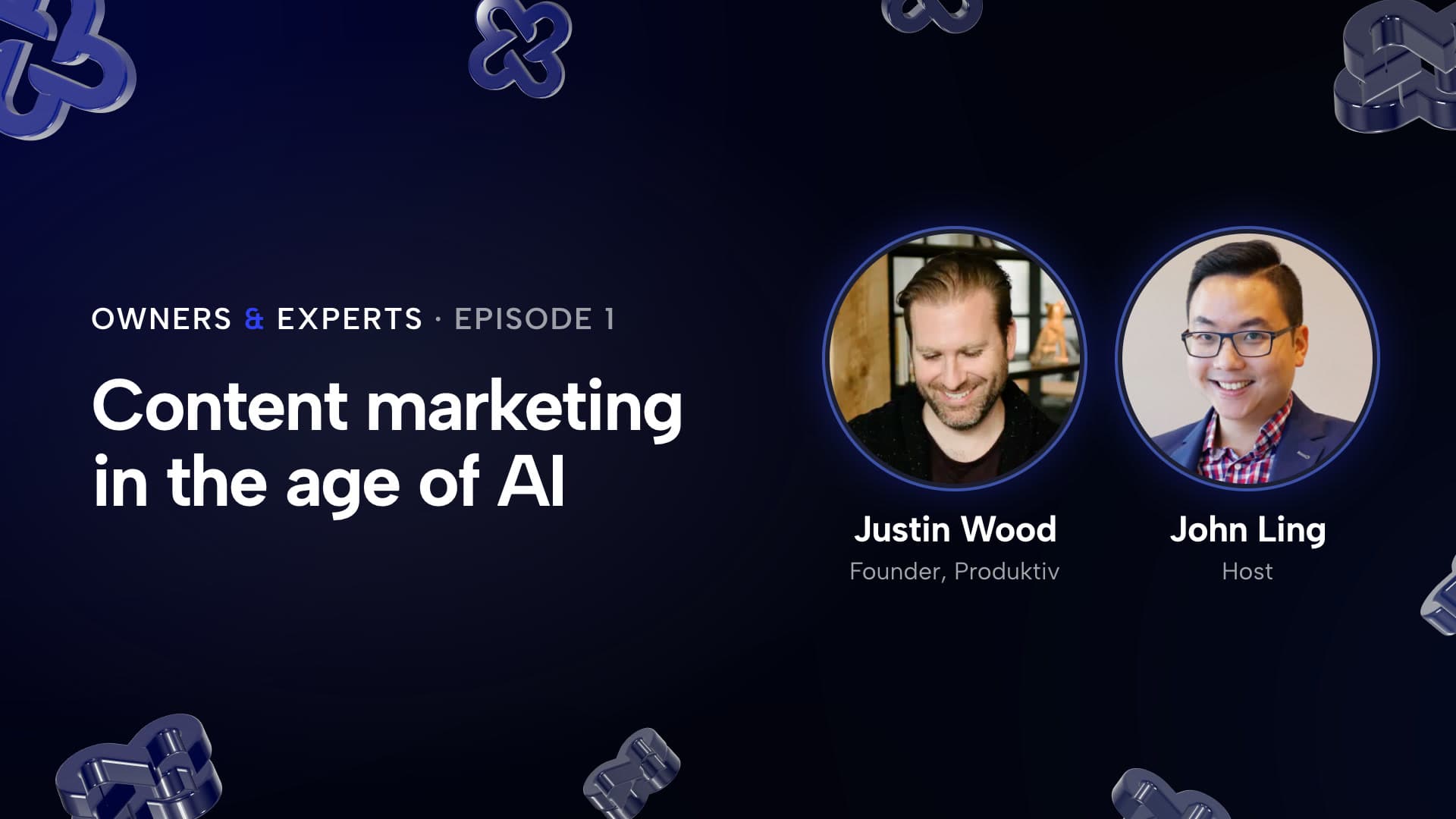
Owners & Experts · Episode 154 min
Content marketing in the age of AI
Justin Wood, Founder, Produktiv
AI just made your expertise cheaper. Justin Wood, founder of Produktiv, says trust is what’s left, and that a $5–20M firm should build a product around it.
In this episode
- Why the $2–5M stage is a “valley of death”, and the difference between an owner and an entrepreneur
- How a podcast built his pipeline, and why it only works if you’re curious rather than selling
- The Wealthsimple test: why a $5–20M firm needs a product, and why the product is the marketing
- How to tie every dollar of marketing spend to a dollar of revenue
- Why “boring” AI is good news for owners
Try this week
- Write down the five questions clients ask you every week. That’s your content, and maybe your first product.
- Tag every link and QR code so you can tie a dollar spent to a dollar made.
- Record one real conversation with a client or a peer, and put it out.
Chapters
Links
Justin and John worked together back in his KRFTWRK days, and have traded notes on their businesses ever since. This episode isn’t sponsored.
Read the transcriptHide the transcript
Justin Wood: If you're not the smartest, most intelligent thing on the planet, then what do you have? What I did when I saw this, I looked at my team and I said this. We're building a studio. Because yes, AI can outthink you. But it can't out-trust you.
John Ling: If you run a five to twenty million dollar firm, AI just makes your expertise cheaper. Justin Wood thinks trust is what's left and what makes you relevant to your customers, and he will show you what to build with it in this episode. Welcome to Owners & Experts. I'm John Ling. This show is for Canadian business owners, the ones who've grown past the startup stage and are somewhere in that five to twenty million dollar range. Every week I sit down with someone who's figured out a piece of that, and I try to get them to tell me exactly how they did it. Today that's Justin Wood. Justin runs Produktiv, and he's been building marketing engines for about sixteen years. Here's what got me: he can trace his clients back to specific episodes of his own podcast. Full disclosure, Justin and I go way back. We built Flipp's design system together, back when his shop was still called KRFTWRK. Justin, you've been in-house, agency, and a startup. What's changed about the playbook?
Justin Wood: I I've done everything. I've done startup, I've done in house, out of house,
John Ling: You've done a lot of things.
Justin Wood: I've done out out out of out of the like pub out of the like it doesn't it doesn't matter, right? like like and and I find that like lots of that is just so irrelevant these days. Like the experience that we we build as like professional marketers and like the people that have built these things with our hands. it's important. But I feel like nowadays the playbook is just com completely different. So I I don't know. I've I I'm is it an existential crisis that I'm having? I d I don't know. But
John Ling: mm, we we talked about this like no in our personal times. We we talk about the idea that I'm assuming that the reason why you say it's a completely different world out here is because of AI, right? It's just like anyone can be anything now.
Justin Wood: Well it it's it's it's further than that. It's it's you're not the smartest being on the planet anymore. and it y you s no,
John Ling: Okay. You're going that far. Okay, cool.
Justin Wood: I I I totally believe it. I totally believe that like The things that that an AI algorithm can produce are way way better than what lots of people can produce. And and you just have to deal with that, you know. I'll I'll never forget when ChatGPT first came out. I had a team of writers, great writers, excellent writers. And You know, we were working on a client and we were really struggling with the messaging for this one client. Like messaging is absolutely everything with any kind of marketing, especially product marketing. And I remember being like, Okay, no, that's not gonna work. Let's do another version of that. Weeks and weeks of just testing lines and this. And then I I I put a brief into ChatGPT. This is like 2022, it like first week it came out, and I was like and I s I was like, this is better. So I mean I went I went to my copywriting team and said, like, what do you guys this is better than what you wrote. This is better than what I could write. Like like
John Ling: This is like GPT three, right? Yeah.
Justin Wood: here's here's the thing. I'm an English major. I s I like I studied writing. I I I studied how to write, why to write, all of that. But i I I it's just it's better sometimes. And not to say that like looking things over and and like directing it it why is it good? 'Cause 'cause I'm a great director, right? It it's not doesn't matter about my ability to sit there and craft the perfect sentence. It's now my ability to be like like that meme of the of the guy with the the whip and like ChatGPT and and Claude and he's whipping it, right? I can direct, right? So so yeah, I mean for for me What's fundamentally different is that people need to change how they think of their work. The people that are like I see really crushing it right now are the people that are that were like at director level, that have experience managing teams of people and seeing the big picture, those are the people that are just absolutely thriving, kind of stuck in their basements because they're so excited that they can. have that cr direction without the egos, without the without the politics around it, and it just gets the the vision gets put directly how, you know, visionaries believe it. So yeah, I mean that's that that's what's
John Ling: Yeah. So take the people
Justin Wood: changed.
John Ling: take the people management out of a manager's job. I think that like everyone gets happier, right? Like manager or director level person. I totally understand where you're coming from. but this brings a c question for me. Like for a business owner nowadays, right? you probably talk to a lot of like no different businesses that need like no That director role in marketing seat, let's say like a ten million dollar business, right? What does that look like now? Like you know, what is a problem that they would come to you with? Like, yeah, what what are they looking for now?
Justin Wood: So like the thing is is that that that area between like five and twenty million dollars is like it's it's they say with any startup, any any company, the first million is the hardest. So many companies don't make it the first million. The second million is inevitable, right? But the two to five million range is what they call like the valley of death, right? And I've known this, I've I've experienced, I've been in the Valley of Death. It is not nice because in the valley of death, that means that you, as a a business owner, can no longer control things anymore. And that's what I think is the biggest difference between a business owner and an entrepreneur. Right? There's a big difference between a business owner and an entrepreneur. A business owner is your mom and pop shop that everybody's like I I know a lot of successful business owners, but If they're not there, the place falls apart. And and
John Ling: Mm-hmm. They have a job.
Justin Wood: you ha exactly, right? You know, financial I know some amazing financial advisors that are are great, but you know what? At the end of the day, sometimes they'll have I got a really big problem. Who do I call, right? So I would say that like pre AI, that moat was like very difficult to cross because When you were when you're going from that like business owner to entrepreneur, like growth, expanding, taking yourself out, it was very expensive investment to get out of the valley of death or the tr the trench, right? You have to invest in software, you have to invest in systems, you have to invest in SOPs. Now it's like The cost of that has been drastically reduced. But my thing is is like, do do you have the ability to think that big? Right. When you so like when you're in that five to twenty million range, you're like, wow, like this thing's really growing. Like it like it's not so much growing at at that pace, it's it's like managing the growth, right? So yeah, like Now now with like agents, v like being able to code without having to raise do a do a huge capital raise or even a small capital raise to to to build a development team. it just I think it's the most exciting part, like part of the industry is that like five to twenty million dollar range where it's like, okay, it's time to scale. Now how do we do it? Never been a better deal to to do that right now.
John Ling: Right. And I guess like when people like I I I think that our intended audience would be in that situation, right? Like but they're thinking, How do I scale? Right? The difference is that I remember when we first talked and like you were telling me that like yeah, like no podcasts, you have a podcast, right? podcast drove a lot of your business, right? And like to be honest with you, I would say two months ago, I didn't really understand why podcasts because there's so many of them out there, right? But then it's because of podcasts that we we start con connecting again. Right? So yeah, like you know so for me, like no, podcast is making its its purpose for me already 'cause we got to connect. So yeah.
Justin Wood: So so here's here's the deal. And and I'll take it back to that ChatGPT reference, right? If you are not any AI reference. If you're not the smartest, most intelligent thing on the planet, then W what are w what do you have? Right? It it's an existential question that we ask ourselves. And that's what the industries spent years on on stupid LinkedIn posts. I'm afraid of AI. what about this? What about my job? Right? Okay. Now, what I did when I when I saw this, I looked at my team and I said this. We're building a studio. Because yes, AI can AI can it can outthink you. But it can't out trust you. Right? I was I was driving driving my car the other day and there was a an ad for some, you know, financial company on the radio and they're like they were called like IA or something, but they're they made a a radio thing that was like, I got my financial advice from from AI, but apparently it makes mistakes. Trust, right? So people buy from people they trust, right? So it Who's winning right now? It's the YouTubers. It's the creators. It's the people that have their face that, you know what? AI, it's at scale. There's so much. But like, I trust this guy because cause I can see his face. I can s see the frameworks that he uses. I can see him do do it in person. That's that's where you you, you know, at least in professional services, like that's how you move forward, right? Because there's no other advantage other than Than your personality, your instinct. Like what AI doesn't have is it's not an animal. We're an animal with instincts, with with I'm having a conversation with you. I can read your body language. I can be like, this meeting is going horrible. I need to switch gears here, right? So so I mean, that's the thing, right? Like you what what what podcasting, what any type of content, it all has to be video first now. And it it has to you have to establish a relationship with another person, right? And and yeah, and the value right now is an audience, right? The people with the the bigger audiences are the ones winning right now. It's not the people with the most advanced AI because everybody has the most advanced AI. It's the people with audience.
John Ling: Cause I like you know, when we when we talked about podcasts and you mentioned that hey, like through podcasts, you were able to drive your pipeline. Like, you know, all you can attribute every single cust customer to a pipeline that you ha you you built through pod like podcasts. Can you tell me a little bit more about that?
Justin Wood: Easy. Like it's marketing one like the fundamentals of marketing I I find is like ver i it's
John Ling: Never changed because the even with A
Justin Wood: it doesn't like digital marketing. What is digital marketing? It is getting a database of email addresses, right? So for me, like you know, we we did advertising, advertising was is still pretty good, but I found that like a professional service, people buy from people they trust. So how do you connect with people? You talk to them. Like I hate I hated networking. I hated going out to like a trade show sh like like a a trade show floor is like my least favorite place in the world to be in. But I like people. I like having one on one conversations and connecting with people. So I just thought okay I like doing this. So I just started emailing people hey Let's talk about that project that we did. Hey, let's let's let's talk about this thing that you're building. And you know, every time someone walked in, by the way, can you do this for us? Can you can you can you build this website for us? Can you w I've always had this idea for you know, this thing. And somebody walked in the door and I just would attribute it. Everybody who was on the podcast usually became a customer or referred me to someone, right? So, you know, for for me it was it's worth it was worth it to pay for the rent for the space. It was worth it to pay for the production of of the podcast. And yeah, and you look around and you see it everywhere. Like all all the all the people that have that that audience, they can monetize it, right?
John Ling: Yeah, thankfully you did it almost pre AI, right?
Justin Wood: yeah, it was like it was before you could get an agent to cut up your clips and do like it was like, hey, video editor guy, w when can you do this? But that's it. It's everything is everybody produces at speed right now and the people that are producing video at speed are the ones who are winning and have options.
John Ling: Basically like just not flooding, but letting people see the authentic you kind of thing, right?
Justin Wood: Yeah, but like what I find is like you have you kind of have two groups. You have the creators that have always been creating and they're really good at it. But their problem is they don't know how to like they know how to build an audience, but they don't know how to build a business. Right? So so they'll have this audience and then they'll be struggling, like, how do I monetize this thing? How do I but you never had a product to begin with. Right? So like for me, like going back to that, like Five to twenty million dollar company, whether it's you're you're you want a a bunch of car washes or you have an accounting firm, you you're in the position where you have a product already. You just need to build an audience around that product, but you have something that leads to a dollar amount, right? Problem is with that, is they're not creators, right? Most businesses aren't creators, they don't. know how to tell a story. They don't know how to, you know, look someone in the eye and ask them and they're afraid to ask like difficult questions. Right. So that's that's the gap that I think like needs to be filled a little bit more in the industry.
John Ling: And a couple of things there. First, like I guess I'm one of them. Like this is like the first time hosting for me ever, right? So I it's it's a big hopefully first of many,
Justin Wood: Mm-hmm. First of many, hopefully.
John Ling: but like no, it's a big mental hurdle to get across. the thing that I I do want to like like call on is that when you mentioned all the customers are coming through your podcast, like you know, pipeline as a pipeline. How many are we talking about? Like, you know, is this like is a podcast driving almost all the business and like you know how like how many clients did podcast end up generating these contracts for you?
Justin Wood: Honestly, like it it's like I I think at like one year's like maybe twenty percent of revenue. but like for me like I like numbers are irrelevant to your audience, like f like who who cares like if it's a two two million dollar business or twenty million dollar business, it it it's irrelevant. Like what makes What matters more than anything is how many people that you interview and how many of those people turned it into revenue or projects, right? So like for me the numbers just made sense. Like like one interview leads to a hundred thousand dollar contract, it's definitely worth the afternoon, right? So
John Ling: For sure. Yeah. Yeah. I see.
Justin Wood: and but but you have to think what I started doing was like okay well I need to make sure that I have a way to engage with these people. So for me it was like okay, if you do want to work with the with the agency, here's package A, B, C, D. Like move them through. So like, you know, five thousand dollar consulting package or you know, like th this person like you need to build those hoops in place so that like if the opportunity does arise you can quickly like turn them around. Right. Cause like writing quotes and and doing all that is just well it's easier now. But yeah. It's you want you want to like build ha when you're doing content, you need to have a sales funnel to support it. Right. And it in and it can't be pushy. It can't be like you're coming on my podcast so I get money. Like people see through that s***, right? Like they should just you should just wanna help. And you just sh you have to come into it with like my podcast was called The Katalog and I just love learning out about digital products and the people that build them, right? So for me, I didn't approach it with like this is what's the ROI of my podcast gonna be? 'Cause I was like, I wanna see what cool cool s*** people are building. That's it. And because I had that passion for that, it c it comes out in your questions you ask people. Like if you don't have that authentic auth authentic authenticity, then your your audience is gonna see through it, your guests on your podcast are gonna see through it. And yeah, so like you have to start doing it with yourself and and for a passion.
John Ling: So first question. in like I I guess in some ways, like you know, we are both in services business, right? How often do you get and like you know from my experience, there's two groups of these like business owners that engage our service. The first group is the group that thinks that, hey, this is something that's easy now, I can just get ChatGPT to do it and that's it. I'm done. Right? And there's a second group that thinks that, you know what, AI is super scary. I know I can probably use ChatGPT to do some things, but it's not going to fit for my business. What do you think? Like what do you see? And like how d how has that perception changed your relationship with your clients?
Justin Wood: Well here here's the thing. I I'm I'm I'm not taking on a lot of clients right now. Like to to be in in all honesty, I'm built like what excites me is building products and like For for me, okay, there's a group everybody's using AI, right? Not everybody, but it it's quite popular nowadays. Exactly. So one
John Ling: They're they're using AI in different ways. Yeah. Yeah.
Justin Wood: of the biggest graph or like most interesting graphs I saw was basically like AI adoption. So there's people that open up their phone, hey ChatGPT, how do I, you know, how do I fix this faucet in my house, right? That's something like ninety percent of ChatGPT users, right? The other like yeah I'm paraphrasing here, but the other like eight percent is people that are using it for work. Hey, answer this email for me. Hey create this slide deck for me so like actually using the AI to generate work and then there's the very small percentage of people that are doing They're all vi they're all vibe coding and and developing right now. So that's like I'm I'm using CLI, I'm using MCP, I'm and like I would say like the that's not for everybody, right? That's just like when the internet first came out, there was people who set up hosting servers and databases and SQL databases, like Those were those people. And that's who I see as the same people that are doing that level of of AI, which is like the the top per the small but top percentage of usage, right? These are the people that are crushing crushing through their their usage credits that are looking to optimize it because they're just so efficient. And these people you don't see them in the wild anymore. I if I talk to all of the people that I know that are that were the builders that were advanced on that level, they're all creating products right now. All of them. They're spending their evenings, their weekends just creating product because we realize that how expensive, how complex these things were to do before. And we feel like this is the opportunity to to do these things, to set these foundations. And these were always the things that were like that five to twenty million dollar gap. Like holy crap, like like I I've run a business that that got into that like two to five million dollar trench. I know that the only way through it is through systems like like SOPs. Standardization and data. Yeah, and processes. It's training s if it's staff, it's training it. If it's agents, it's training them. So like back to those two groups. like one that don't trust it. I don't I think most of those people that don't trust it have never built a business past two two to five million dollars. They just don't understand it. Right? They like if you if you've built a business where you have to remove yourself, you realize how powerful these things are and how important they are to to build, right? and what was the other group?
John Ling: group that thinks that everything's easy. You just tell it to ChatGPT, it happens. Yeah. Yeah.
Justin Wood: that group I would say is kind of like Honestly, they're not wrong sometimes. Like like they're they're not wrong. But I think there's it's overhyped, right? So like there's a lot of hype. where people will be like, you can do anything with AI. And and I've felt over the past few months where you have the mo the largest companies just shoving that down through their influencer networks, right? Like I did this in two minutes. And there's a lot of there's a lot of crap around that. And I find that as I've been actually like And I want to be that optimistic. And I have been that optimistic. But what what I found is as I started building products of my own, is that I'm doing what the develop like I'm sitting there on GitHub doing like managing PRs. I'm I'm opening up a spreadsheet to make sure that my data is accurate. There is there is a lot of once you invest. your time into that and it starts sucking and you see how much value it brings, you need to have a director mindset that can can know where it's going and guide it in the right way. It's like having a ship ship without a compass, right? So yeah, like I'd say it's closer to that AI can do everything ship. And I think that the I don't trust it thing needs to I'm I was sick of it last year. I'm well, I'm I was sick of it last year, I'm even more sick of it now. And to be honest, lots of it's like these new AI models that have come out in the past six months have really shut that camp up. but the question is is like why are you doing it? What business goals are you going towards and like How are you directing it? So
John Ling: I I I've seen I've seen companies that have passed through the five million dollar mark and they are they are seeing through their past experience that AI isn't doing what it needs to be done because they don't have the necessary data or the necessary infrastructure built out so that the AI has the right access. To be able to do the things that they expected to do. Right? It's almost like, yeah. So I think that like no, that's a gap. And like, you know, that gap happened because I I I would assume most of the like you know, five million plus business owners or entrepreneurs, like you know, as your based on your definition, they're there because they're willing to try stuff early, right? And when they tried it, it didn't work. So but they haven't they don't realize how quickly AI has been progressing.
Justin Wood: people have asked me like you know, Justin, why aren't you growing your agency? So first of I I've grown an agency before, been there, done that, built products for people and I've seen that to actually increase the valuation of your company, you need a product. And what is a product? You need data. And and so so I mean, open up Supabase. Get going, like get a b start with a database and and
John Ling: Yeah. Yeah. Yeah. Yeah.
Justin Wood: and but you know back to the back to the data thing it you have to build a product right so and it's never been it's never been cheaper and more efficient to build a product Right. So So for me it's like if you're if you're in that like five to twenty million dollar range and you don't have a product, like you're just mis you're you're leaving money on the table on your valuation. Right? because if it's a f a five to twenty million dollar accounting firm and all your all of your records are are sitting in some you know, filing cabinet and you can't unleash like the power of AI up upon it 'cause it's not the data isn't there, then you're missing out, right? You y and you're you're always gonna have to grow your sales force city by city, like handshake by handshake. Whereas if you have a product you can onboard at scale, you can automate the process at scale and Yeah, so I think ever every company in that range has to have their own if they don't have a login and a and a portal or a mobile app or a like you're just losing out on valuation. Build build a product right now. Just do it.
John Ling: You know, I remember last like we talked about this last Thursday. I think you you gave a very good line. You said that the product is a marketing now. Remember? Yeah. And you so I think the question I have for you was that like you know, how would an accounting firm have a product? What did you say again? Like you I think you said something along the line of how about a tax calculator, right? Or something as simple as that. Yeah.
Justin Wood: look at Wealthsimple. Like you you walk into any like financial advisor, hey man, like what what's the plan for next year? Or let me pull up the wealth and the and they'll Google tax calculator, how much did you earn this year? Boom, they're into Wealthsimple. So like I walk out of that office and I'm like, okay, well, why don't I just use Wealthsimple? Why am I p charging this guy a fee to do this? Because they built a product. And and And because they know what their customer experiences, it starts with the tax return. They they opt optimize and rank all of their SEO pages for people to go in there and it gathers an email. Email equals database. Database equals free marketing. So when I say that like the product is the marketing, like the strategy starts at your product. Like what's like the product and the product is understanding the c the customer and building a self-service around them. Right. and like working with enterprise, they just don't get it. Like enterprise doesn't get that sometimes. That you know, they built you have a you have banks on every corner that are built on being the community bank. And then what happens is someone comes in and and understands the the actual customer experience that nobody likes sitting in in a in a dusty a** bank chair. And and they would and they they don't like scheduling around, you know, some bank manager who's on vacation half of the time, right? Just give me a tool. Give me a tool. I'll put my data in it,
John Ling: Or the hours. Yeah. Yeah. Yeah. Yeah.
Justin Wood: I'll calculate it. But you have to build that tool, right? And I've built that tool for enterprises. And and and that's that's how that's how they would win. They would just out tool, out tool and and out convenience. Convenience is number one, right? So like But there was always a gate for that. To build those tools, you would have to like you would have to go raise VC money, hire a team of developers, and do that. And you know, minimum a couple million dollars to a couple tens of million dollars. And Enterprise never was good at it because they can't move fast, right? So yeah. So like yeah, so
John Ling: Well and you need a team to do that, right? But now that has changed. Yeah.
Justin Wood: before it was like enterprise. would invent in invest in digital tool and stuff or in a a digital arm of what they did. And now it's like it's kind of kind of open for yeah, especially I think that mid market because you do have data. So it's like what are you doing with the data? And how do you like increase the intake to that? And it has to be a product. You have to build a product.
John Ling: Right. Perfect. And that can take us to the product that we were talking about quite a bit, like Trakt, right? Let's talk a little bit about that. how would a business five to twenty million dollars in in revenue, how would they use that? Like you know, and what is the problem that it solves for them?
Justin Wood: Well, like that's w that's where it happens. I've spent a lot of people's marketing money, right? And so much of marketing is just guess game and like like you you worry about vibe coding. Like marketing's been running on vibes for like centuries. Right? Ye well like
John Ling: Because no one really knows, right? Yeah. It's about yeah, yeah.
Justin Wood: And again, it comes back to data. Is your data clean, right? So what Trakt is is it basically is an attribution tool. If you look at any any marketer who gets who's is actually good at attribution, and let let's take it to a consumer. You're shopping, you click on a link, you have this big fat URL with a whole bunch of like source, medium, campaign, and all of that. Like the marketers that know how to Tag all of their advertising efforts, whether it's a Google ad, a Facebook remarketing ad, a coupon code for a giveaway or something like that. Marketing is dead simple. If you can track like a dollar that you spent to a dollar that you made, it's it's better than the stock market. If you have a product to sell, marketing is the is the best stock you'll ever invest in, right? So
John Ling: money, basically.
Justin Wood: this is i if you get marketing good, you're printing money. So what Trakt does is it it basically is a way to standardize all those so that the data is clean when you when somebody fills out a form on your website. and it's specifically for for more lead gen and less e-commerce. So for lead gen, it's very difficult to know like when was the last point that led to a sale or which touch point. So what Trakt allows you to do is Standardize all your links so that when people interact with your website, fill out demos, and and ultimately lead to a sale, you can attribute it back to the dollar that you spend. So going back to my podcast example. So like if I had someone sign up to my podcast, from the moment they like sign up to submit their their topic or something like that, I can I can tag that they came in through that. Or if I had a cyber truck and I had a QR code for my roofing company. And it was like get a free quote, and I and someone you know scanned that. I could say
John Ling: Can cure a code? Yeah.
Justin Wood: that hey, Cybertruck One in Toronto got you know it it at least paid for the lease of the Cybertruck and and it and it also generates ten ten grand a month in in new contracting revenue. Right. So like that's the the simplicity of marketing that most people forget is like They're so concerned about what tactics working. and they don't think about the fundamentals of like, how are you tracking all those tactics? That's the most important thing.
John Ling: Yeah. And I guess like, you know, that that used to be something that like, you know, you're offering as a service to through an agency, but now with Trakt the product, you're now offering this service in a much more elegant way that any of your tactic agency customers or whatever can then use this to track every to track everything, right?
Justin Wood: Yeah, and and honestly, like we built it as an operating system for the agency at first. So when when you get so good at marketing for people, like you're like, holy s***, I would rather have a cut of the pie. I would I would rather I would rather be like, you pay me for performance. Cause like that's what I hear agencies say all the time to me. They're like, they could be spending much more money. And they could be getting a lot more money back. But
John Ling: they know the equation. They know the formula. Yeah.
Justin Wood: but lots of times like agencies they're just worried about like what's our cost per acquisition or like getting their advertising cost down. They're seeing marketing as a yeah, yeah, as like an operational cost, right? When really
John Ling: I mean down the cack. Yeah. Yeah. Yeah.
Justin Wood: like like is like if you so what what I wanted was like okay, I'm gonna go generate leads for you and I've dra generated millions of pipeline. I would rather I I can't make my call on how much more revenue gets closed if you don't tell me the quality of the leads and and the and the value of the o opportunity that closed on that. If I have that data, if I know that my Cybertruck that I that we we we have out there is actually paying for itself, if I don't know that, then I'm just I'm just going around and optimizing on a on a thing and I'm completely in the dark. So So there needs to be a tie-in with revenue and and that ad spend. And if you can do that, you can scale. Right? And if you can't, then you sit there and you blame the marketing guy 'cause the color isn't right on on the the frickin' banner or something. So branding, right? Well let's build a brand, right? You you look how on the like every AI tutorial is like how to build a website. Like let's take let's build a website with with AI. you look at like some of these like really good people that like get amazing results with with their output, but the fundamentals are the same. Right? Like start with a mood board, start with like ask these specific questions for on for like to to get to the bottom of how someone was really and like before it used to be like you'd come in with a suit and and like like every agency had the same process, right? Like because we we know how to get to the to the bottom of it, right? Just like a lawyer would would ask you the the same question. So so when I say the product is the marketing, like Think of your content marketing. It's all around the questions that people ask you all the time and the processes that you do all the time. Right? And of course you can build that into an agent now. That's way better to build into an agent now, right? So like one thing that that I I built like building too many things. And they said like vibe coding is an ADHD entrepreneur's wonderland. Which which I
John Ling: Yeah, it's a it's a drug. You can't yeah. Yeah.
Justin Wood: Yeah, I know. It's totally it's an ADHD entrepreneur's wonderland. And I was like my wife's like, How many things are you building right now? And I was like, well Like one one of them is for websites, I I a couple years ago I I went to my team, I'm like, yo, who are these people selling like five hundred dollar websites? Like we're doing like you know, we're doing it but like yeah, like well I I was just like,
John Ling: How do you do five hundred dollar websites? Good. Like yeah.
Justin Wood: Well like how do you make that prof like you can do it, anyone can do it, but is it profitable or worth your time? Absolutely f— not, right?
John Ling: Yeah. Yeah. Right. Right.
Justin Wood: but like But that sat with me and I was like, hmm. So yeah, like I built a sub brand called like a sub brand called Ollie, which just does all the SOPs, like it it guides people through onboarding, like what style do you like? It builds the mood board. So it does all those SOPs and process in a product. And yeah, like you you can If you can run that without the operational cost of the back and forth and the and the zoom meetings and the and the back and forth on calendar invites, like just build a pro build a product for it and then test that with the market. It's a it used to be such a risk to do that. It used to be so much time. I I'm not lying when you can when I say that you can really I don't think in a weekend get a a good product, but I think in like a couple of weeks you can get something that people can use. And yeah.
John Ling: what's exciting you right now with like all the things that's been going on? Like anything that's really exciting you for the people who own a five to twenty million dollar business, like what do you think is exciting that like those people should know about it?
Justin Wood: Yeah, so w I think what's exciting me is the lack of excitement I've been feeling around AI lately. 'cause
John Ling: Hm. Why? What do you mean?
Justin Wood: it feels like it's leveling out to a point where we can actually get some work done with it. if you asked me six months ago, it was it was so exciting and so brand new. world with like vibe coding and and stuff like this that I I couldn't recommend it as an agency service. I'd be like, I I don't know where this is going right now. And I don't know where these updates are going. But I think the fact that We have these models that everybody's working on that are that that have good connections, like MCPs are are great. it's dependable. Like the the the
John Ling: It's dependable, no? Yeah.
Justin Wood: the boring the boringness and the dependability is where I'm like, hey, I can confidently say to you, go build a product right now. Find find somebody that that knows how to guide it and and has the experience and vision, especially somebody who who's built it the hard way. If you can find someone who's who can who has built it the hard way and is trained in these tools and and knows how to like guide it forward, like invest in that now if you actually want to grow, but only if you really want to grow. So like that that's exciting for me is like, okay, we've had fun playing around in our basements. Let's build some businesses. and and it's not just you know, the story about a a a kid who built something in a weekend and is valued at, you know, three billion dollars. It's it's the the businesses that have been running for for years and years and have always thought about how things could be bigger. with more locations, with with with an online presence. yeah, like I I generally just want a middle class in North America and I think that that's the way to get there is through small businesses growing and and having more c competition. Like I want consumers to have more choice. I I want it to be like digital products and apps are more like your your local like your your local businesses. So like there's specific niches f for for use specifically and like you can have custom software to like exactly what you need. and because it's all built on this intelligence, I I think it it'll be like the next internet where it's like you'll have your agents and and all that. But like you need a product and an interface still 'cause you are a human and you need to like use it. Right. Like that's the thing too. It's like I I want to see what excites me is those those new interfaces that actual people will use 'cause like I'm a I I I'm I'm that AD ADHD entrepreneur. I like we will open command line, we will but that's not the average person. I wanna see like the average person using a new group of interfaces and yeah. Google was the most important thing because it because it was just a simple search bar, right? ChatGPT like revolutionized that
John Ling: Yeah. Yeah. Yeah. Change that. Yeah.
Justin Wood: by having a chat interface for for these things, right? Now what what you're going how I believe that how we fundamentally use computers now for for like the more advanced people not like the top percentage of like power users. I just I remember a couple years ago like working and marketing was going around clicking. And it's like clicking this, clicking that, clicking this, seeing this dashboard. And now I remember coming to my office a couple months ago with my team and we were all everyone was typing, typing, typing. It was like a
John Ling: Yeah, yeah.
Justin Wood: And then like that that's fundamentally like how you will use a computer now. It's like directing it. So I think like yeah building what's good where it's gonna go is like if I sit down, I wanna visualize things.
John Ling: I feel like no we yeah, like it the the world is changing so quickly in the past like two years. Like you're right, like a year ago, we can't keep up, yeah. It's it's crazy. Yeah.
Justin Wood: It's you can't keep up, man. Like well, like what what keeps me grounded is like seeing fundamentals work faster. That's like it's just just keep with the fundamentals. If I look at all the startups that I built, like they they had r s fundamentals. One was like they had content in editorial. I never saw a startup grow without organic traffic in some sense or form. What that was in twenty thirteen is di looks different in 2026, but the fundamentals are the same. You you do content that builds trust with people that leads to an email subscription, right? That hasn't changed. they know how to get good ROI on their performance, which is why I built Trakt so that you could see what dollar spent and dollar made, because otherwise you can't scale past a couple million. They had a good product. So the product was good enough that it could handle that scale and automate people in through the in through the onboarding, the qualification, the sales funnel
John Ling: And driving value. Yep.
Justin Wood: and have life lifetime value through a login and a product. And the final thing was the brand. Like like does can can the brand handle that growth? Can it expand in a way that that keeps that trust and and and gains it through all of it? And that's that's like the the fundamentals of of the agency of of Produktiv. So like AI, love it, down for it, but like with those fundamentals is very powerful. But the problem is that everybody's going around chasing the next shiny tool and tactic that the AI can do without thinking the big picture and how to apply those fundamentals. Which is really the the thing that's most exciting about it is like, hey, I can I can do a a a ten million dollar marketing push with a ten thousand dollar budget. You know what I mean? Like maybe not ten thousand, maybe a hundred thousand, but it's still like a good multiplier.
John Ling: Right. I think that like no, you're hitting on like what I what I've been thinking about this AI move. I think that work is no longer the value. The value is sitting in the judgment. Right? The people who
Justin Wood: Yep, a hundred percent.
John Ling: are experienced enough to actually make those judgments, that is valuable. Yeah.
Justin Wood: small pe like it's very small percentage of people that make it to like a director level in their position or above.
John Ling: free AI so that they know what the principles are. Yeah. Yeah.
Justin Wood: mostly elder millennials, I find. Yeah. And what are they all doing? They're building products right now. Everyone I talk to. Every everyone, what are you doing? I'm building this product. I'm building this product.
John Ling: It's just the way it is. I think that yeah, I think that there's a personal note on on on a personal note, I also worry about my kids. I'm sure like no like what are they gonna do? I don't know. Right?
Justin Wood: I I no here's the thing, like it's a like I think if you look at like kids aren't dumb, right? They they s I asked my daughter yesterday, she's like, I wanna be a s a a pop star and skincare influencer, YouTube. So like they see who like they have idols. Right? And who are their idols? Like the number one job that kids were asked that they want to be when they grow up is YouTuber.
John Ling: All three are my kids. That's what he said. Yeah. Yeah.
Justin Wood: Because it's Because th those are the people who are winning. Like i when I was a kid I wanted like I wanted to be a a professional skateboarder 'cause it was A cool. B they got to travel and got paid a lot of money. And it was glamorous, right? but the fact of the matter is is Person, it goes back to what I said earlier. The personality, people trust the personality, and you can always build a product out of an audience. Before, marketing was build the product and then build the audience. Now it's build the audience and then build the product around it.
John Ling: Mm-hmm.
Justin Wood: Right? So I think that's like if Gen Z and Millennials, they're they're great at building the audience.
John Ling: Is that?
Justin Wood: s 100%. 100%. Like, like they they are they get it, they're comfortable in front of the camera. They like my my daughter watches this one guy who all he does is just go around and he just does stuff. I'm like, what is this channel? It's like, he just like does stuff. But it's his personality and it's just like he's comfortable and in a world where they don't go outside, they have a connection with that person, right? All he needs to do is build like, hey, here's my stuff app. Mr Beast, here's my chocolate bar, here's my energy drink, here's my skincare line, right? Yeah.
John Ling: Interesting.
Justin Wood: So the the businesses need to build audiences and the people with the audiences need to build businesses. Yeah.
John Ling: Three things to try out this week. One, write down the five questions clients ask you every week. That's your content and maybe your first product. Two, tag every link and QR code so we can tie a dollar spent to a dollar made. Three, record one real conversation with a client or a peer and put it out. Links to Produktiv and Trakt are below. See you next week.
Where are you standing?
Owners
Start with a confidential call.
Thirty minutes on your company. We will tell you straight whether we are a fit.
Tell us about your company

 David, Victor or Toby
Operators
Start with a discovery brief.
One workflow, one question at a time. You leave with a brief to share, and a call with us if you want one.
Start your discovery brief



 Michael, John, Justin, Steven or David
Not ready yet?
New webinars, podcast episodes and the tools behind them, by email.